

If you’ve ever stood at a construction site watching a wheeled excavator swing its arm over a pile of debris to load a dump truck, you’ve probably wondered how operators perfectly gauge just how far that machine can reach without tipping over or missing their target. As a wheeled excavator supplier, I get this question all the time—from new operators just learning the ropes to project managers bidding on jobs that demand precise reach and lift. The core of this puzzle boils down to one critical, often misunderstood factor: boom length. It’s not just a random number stamped on a spec sheet; it’s the backbone of how your wheeled excavator operates, directly shaping its working range—and getting that relationship right can make or break a job.

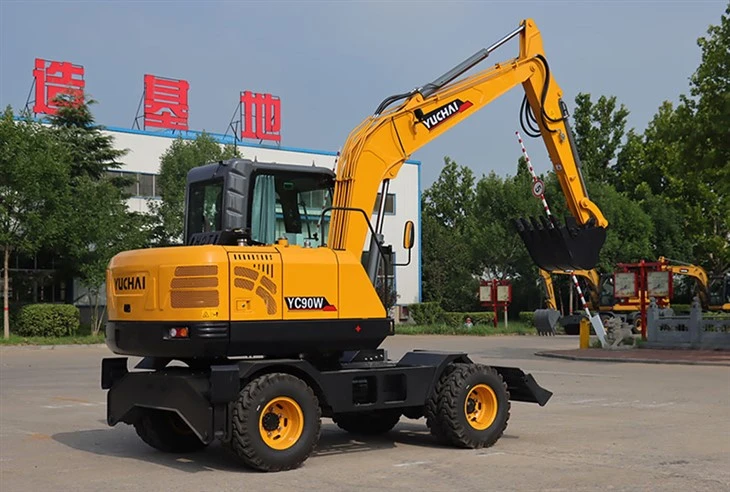
Let’s start with the basics, because before we dive into boom length’s role, it’s important to define exactly what working range means for wheeled excavators. Unlike tracked excavators that stick to a fixed footprint on loose soil, wheeled models have the advantage of driving to job sites quickly and moving between work areas without a trailer. Their working range isn’t just a single number—it’s a set of measurements published in every operator’s manual: maximum digging reach (how far the arm can extend horizontally), maximum digging depth (how far down it can dig), maximum reach at full height (how far out it can stretch while lifting something high), and even the radius of the tightest turn the arm can make around the machine’s center. All of these numbers are tied directly to the boom, the primary arm that connects the excavator’s rotating upper frame to the stick and bucket. Think of the boom as the long “spine” of the arm system; the stick is the lower extension, and the bucket is the working end that actually grabs or lifts material.
Now, here’s the part most people miss: longer booms don’t always equal better working range. At first glance, it seems obvious—if your arm is longer, you can reach farther, right? But that’s a naive view, because every action has an equal and opposite reaction in hydraulics and weight distribution. Wheeled excavators rely on their chassis and outriggers (the extendable legs that drop down to stabilize the machine when it’s working) to counterbalance the force of lifting or reaching heavy loads. Add a longer boom, and you’re shifting more weight farther away from the chassis, which increases the tipping moment—the force that could tip the excavator forward. Manufacturers like Yuchai engineer this balance for every model, so when you look at a spec sheet, a longer boom on a wheeled excavator will often trade maximum lift capacity for maximum reach. For example, our YC80W Wheel Excavator, designed for tight urban jobs and small residential projects, has a compact boom optimized for maneuverability in narrow alleys. Its maximum digging reach is around 6.2 meters, which is perfect for digging foundation trenches or loading small trucks in tight spaces. Contrast that with our mid-range YC160W Wheel Excavator, which has a longer, reinforced boom; its maximum digging reach jumps to 8.8 meters, enough to reach over the side of a road to dig a utility trench without driving onto the soft shoulder. But here’s the tradeoff: while the YC80W can lift up to 2,000 kg at ground level directly in front of it, the YC160W can only lift 1,500 kg at that maximum 8.8-meter reach. That’s not a flaw—it’s the physics of boom length at work.
I’ve seen this tradeoff play out first-hand on job sites. A few years back, we had a customer who was bidding on a street construction project. They initially wanted to rent a unit with the longest boom available, assuming more reach would let them cover the entire 50-meter block without repositioning the machine. But when they tested a model with a 10-meter boom, they hit a problem: the machine could barely reach the trench along the curb without its lift capacity dropping too low to move the heavy concrete debris. Instead, we recommended the YC160W Wheel Excavator, which has a balanced boom length that gave them just enough reach to cover each 10-meter section of the street, and enough lift capacity to haul away the concrete blocks. They repositioned the machine twice per block, and finished the project three days faster than the competitor who had gone with the overly long boom. That’s the key takeaway: boom length is a customization tool, not a one-size-fits-all upgrade.
What also surprises many new operators is that working range depends on more than just the boom’s raw length—it’s how the boom works with other components. Wheeled excavators come in two main boom configurations: standard (mono) booms and variable-arch booms. A standard boom is a straight, fixed arm, while a variable-arch boom has a curved upper section that lets operators adjust the angle of the arm as they extend it. The variable-arch design is popular on mid and large wheeled models, like our YC190W Wheel Excavator. Its 9.5-meter variable-arch boom lets operators reach higher over obstacles while maintaining a lower tipping risk, because the arch shape shifts some of the weight closer to the chassis when the arm is fully extended. This is a big upgrade over older standard booms, which forced operators to choose between maximum reach and safe lift capacity. For example, when reaching over a 2-meter tall fence to dig a trench on the other side, the YC190W’s variable-arch boom lets it extend 8 meters horizontally while lifting 1,200 kg, whereas a standard boom of the same length would only let it lift 900 kg in that same position. That’s the synergy between boom length, design, and working range that manufacturers spend years engineering.
Another factor that often gets overlooked is how wheeled excavators use their outriggers to adjust working range. Unlike tracked excavators, which have a wider, more stable base, wheeled models have tires, so they need to deploy outriggers to eliminate side-to-side tipping risk. But here’s where boom length changes things: when you’re extending the boom to the left side of the machine, you can extend the left outrigger fully to widen the base, which lets you push the boom’s length farther without tipping. If you only need to reach forward (not side-to-side), you can deploy the front and rear outriggers, again adjusting the working range based on boom length. Our service team gets calls all the time from operators asking if they can “cheat” the reach by only deploying two outriggers, but that’s a safety hazard. The boom’s length is calibrated to the outrigger configuration, so deviating from that will throw off the balance. For instance, our YC210W Wheel Excavator, our largest wheeled model, has a 11-meter boom and wide-set outriggers that let it extend up to 10 meters horizontally when both side outriggers are deployed. If an operator only deploys the front outriggers, the maximum reach drops to 7 meters, because the narrower base can’t counter the tipping force of the longer boom. That’s why training operators to understand this link between boom length, outrigger use, and working range is non-negotiable for safe operation.
I’ve also had customers ask about aftermarket boom extensions—add-on parts that let you make an existing boom longer. On the surface, this seems like a cost-effective way to boost reach, but in reality, it’s a risky move that messes with the entire working range balance. Aftermarket extensions aren’t engineered to match the hydraulic pressure capacity of the original boom, and they shift the center of gravity far beyond what the chassis was designed to handle. Last year, we had a customer who added a 2-meter extension to a YC80W, thinking it would double their reach. Instead, when they tried to lift a 1,200 kg pallet of bricks at the extended reach, the front tires lifted off the ground, and the machine almost tipped over. They had to cut the extension off and sell it, costing them thousands of dollars, plus they missed a critical job deadline. That’s why as a supplier, we always advise against aftermarket modifications. Every Yuchai model’s boom length is calibrated in our factory, tested in real-world conditions, and paired with specific hydraulic systems and chassis balance to deliver a safe, consistent working range. Our YC160W, YC190W, YC210W, and YC80W models all have boom lengths tailored to their intended use cases, so you don’t have to compromise safety for extra reach.
Let’s break this down with concrete numbers from our models to make it real. The YC80W is designed for light jobs: small residential excavations, tree planting, and urban utility work. Its standard boom length is 5.6 meters, with a maximum digging reach of 6.2 meters and maximum lift capacity at ground level of 2,200 kg. The YC160W, built for medium construction and municipal projects, has a 7.8-meter standard boom, with a maximum digging reach of 8.8 meters and maximum ground-level lift of 1,800 kg. The YC190W, for heavier road work and large utility projects, has a 8.5-meter variable-arch boom, max digging reach of 9.5 meters, and ground-level lift of 2,500 kg. Our largest wheeled model, the YC210W, has a 9.2-meter variable-arch boom, max digging reach of 11 meters, and ground-level lift of 3,000 kg. You’ll notice a clear pattern here: as boom length increases, maximum reach goes up, but lift capacity—especially at extended reach—adjusts to compensate. This isn’t arbitrary; it’s the result of hundreds of hours of testing to ensure the machine is stable, no matter how the operator positions the boom.
One of the most common mistakes new operators make is not accounting for boom length’s impact on working range when working on uneven terrain. Wheeled excavators are less stable on sloped ground than tracked models, and a longer boom amplifies that instability. If you’re working on a 10-degree slope, extending a longer boom uphill will put more weight on the front tires, while extending it downhill shifts weight to the back. For example, if you’re using a YC160W on a sloped road, extending its 7.8-meter boom uphill will reduce your maximum reach by about 0.5 meters, because the front tires can’t handle as much weight. Extending it downhill will let you reach an extra 0.3 meters, but you have to be careful not to overload the back tires. This is why operator training that covers boom length and working range relationships is so important—even the best machine won’t perform well if the operator doesn’t understand how terrain interacts with these factors.
As a wheeled excavator supplier, I’ve seen how getting this balance right directly impacts job efficiency and safety. A few months ago, we worked with a large landscaping company that was struggling with two jobs: one required digging a 9-meter deep pond, and another required reaching over a 3-meter tall wall to move large boulders. They originally leased a model with a 10-meter boom for both jobs, but the pond digging required so much boom extension that the lift capacity was too low to move the excavated dirt, and the wall job had a maximum reach that was too wide to fit through the site’s narrow entrance. We recommended the YC160W for the pond job, which had a balanced boom length that gave them enough depth and reach without sacrificing lift, and the YC80W for the wall job, which had a compact boom that fit through the gate and was powerful enough to move the boulders. They saved $15,000 in rental costs and finished both jobs on time, which they told us was directly because they matched boom length to the job’s working range needs.
So what’s the bottom line for anyone using a wheeled excavator? Boom length is not just a spec to check off a list—it’s the primary driver of working range, but it’s a tradeoff between reach, lift capacity, and stability. Longer booms give you more reach, but at the cost of lower lift capacity and higher tipping risk. Shorter booms are more stable, have higher lift capacity, and are better for tight spaces, but they can’t reach as far. The right boom length depends on your specific job: are you working in a narrow alley? Go for a shorter boom like the YC80W. Are you digging a utility trench along a highway? A mid-length boom like the YC160W is perfect. Are you moving heavy materials across a large construction site? The YC190W or YC210W with their engineered variable-arch booms will give you the balance you need.
If you’re in the market for a wheeled excavator and want to make sure you get the right boom length for your working range needs, don’t hesitate to reach out to our team. We can help you assess your job requirements, test our models, and find the right fit for your projects. Whether you’re a small contractor just starting out or a large construction firm managing multiple sites, understanding the relationship between boom length and working range will help you make smarter decisions that save time, money, and keep your jobs safe.
References
- Yuchai Construction Machinery. (2024). Wheeled Excavator Technical Specifications. Retrieved from internal engineering documentation, Yuchai Group
- American Society of Civil Engineers. (2023). Stability Characteristics of Wheeled Construction Equipment. Journal of Construction Engineering and Management, 149(8), 04023057
- International Organization for Standardization. (2022). Earth-Moving Machinery – Wheeled Excavators – Safety Requirements. ISO 10791:2022
- Construction Equipment Association. (2023). Operator Training Manual: Wheeled Excavator Boom and Range Calibration. CEA Publication 2023-04