

If you’ve ever stood beside a forestry mulcher at work—its metal jaws crunching through thick underbrush, its spinning teeth churning logs into uniform mulch—you know these machines don’t run on fumes alone. As a forestry equipment supplier, I’ve spent the last decade walking job sites with operators like you, watching both new units with neglected maintenance and well-loved machines that get regular, intentional upkeep. The difference in their productivity, lifespan, and even safety is night and day. This isn’t just about checking oil levels; it’s about protecting the investment you sink into equipment, from daily checks that take 15 minutes to seasonal overhauls that pay off for years. Let’s break down the maintenance procedures for a forestry mulcher, tailored to keep your machine performing when you need it most.
First, let’s ground this in the equipment we provide—because maintenance is never one-size-fits-all. Our line of forestry equipment includes models built for everything from residential clearing to large-scale timber harvesting: the Yuchai F35 IV Harvester Head for compact, tight-space jobs, the more powerful Yuchai F40 Harvester Head for heavy-duty logging, plus attachment options like the Yuchai YCF80S Wood Grabber and Yuchai Grapple FC90 to pair with your mulcher for full-site efficiency. Even the most durable units need consistent care, and that starts with daily pre-operation checks that take just 10 to 15 minutes before you fire up the engine.
Daily maintenance might seem tedious, but it’s the foundation of avoiding costly breakdowns mid-job. I always tell operators to treat this as a ritual, not a chore. Start with a visual walkaround of the entire machine. Look for cracks in the mulching drum or rotor—even a small ¼-inch crack can expand under the constant vibration of mulching, leading to a catastrophic failure hours into a job. For our harvester heads, like the Yuchai F35 IV Harvester Head, pay extra attention to the mounting brackets that connect to your carrier machine; these take the brunt of the torque from cutting wood, so even a loose bolt here can throw off alignment over time. Next, check all fluid levels: hydraulic oil, engine oil, coolant, and hydraulic fluid for attachments like the Yuchai Grapple FC90. Forestry work is dusty, and even a tiny leak in a hydraulic line can let contaminants in, destroying seals and pumps. I once worked with an operator who skipped checking the hydraulic lines on his mulcher and ended up stranded when a line burst 50 miles from the nearest service shop—costing him a full day of work and thousands in repairs. Don’t forget the fuel filter: pull the pre-filter and drain any water or sediment, especially if you’re working in humid or muddy areas where water can seep into fuel tanks. Finally, test all controls: the throttle, the mulcher engagement lever, the grapple controls if you’re using a Yuchai YCF80S Wood Grabber, and emergency shut-off switches. A faulty emergency shut-off isn’t just a repair—it’s a safety hazard, and we can’t stress that enough.
Moving from daily checks to weekly maintenance, this is where you dive a bit deeper into the machine’s systems, addressing small issues before they become big ones. For any forestry mulcher, the most critical part is the cutting assembly: the teeth, blades, and rotor. Every week, remove the cutting teeth (most mulchers have 12 to 20, depending on the model) and inspect them for wear. Our Yuchai F40 Harvester Head uses heavy-duty, heat-treated steel teeth designed to last longer than standard options, but they still wear down as they chew through hardwoods, stumps, and even small rocks. Teeth should be replaced when they’re worn down to half their original size—waiting until they’re completely smooth makes the mulcher work harder, burning more fuel and putting extra strain on the engine. While you have the teeth off, clean the rotor of built-up mulch and resin; this gunk can bake on when the machine is hot, unbalancing the rotor and causing vibration that wears out bearings prematurely. If you notice any bent or chipped blades, replace them immediately—running a mulcher with damaged blades will not only reduce mulch quality (you’ll get chunky, uneven mulch instead of consistent pieces) but can also send debris flying from the machine, a major safety risk. This is also the time to check the drive belts and pulleys. Forestry work is rough, so belts stretch or crack faster than in other equipment. Look for frayed edges, cracks, or signs of glazing, and adjust tension if needed—belts that are too loose will slip, reducing power to the mulcher, while belts that are too tight will wear out bearings. For attachment-integrated mulchers, like those paired with the Yuchai Grapple FC90, check the hydraulic hoses that connect the grapple to the carrier for abrasion from rubbing against other parts or tree branches.

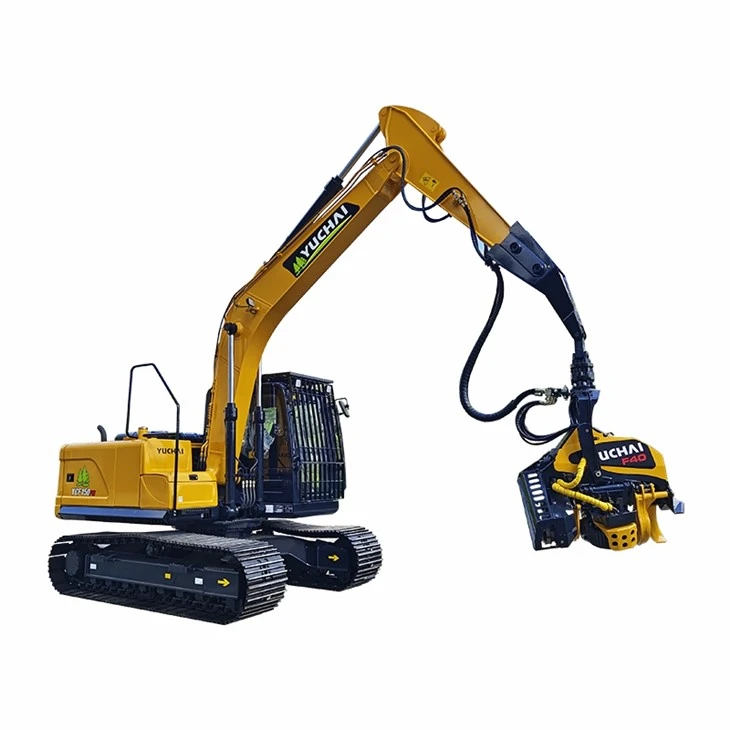
Every month, or after 50 to 70 hours of operation, you’ll need to perform more in-depth maintenance that tackles the machine’s core systems. Let’s start with the engine: change the engine oil and oil filter, and replace the fuel filter. Dust and debris are constant in forestry environments, so oil gets contaminated faster than in paved work sites, leading to increased engine wear. Use the manufacturer-recommended oil—for our Yuchai YCF135S models, we recommend a high-viscosity, anti-wear oil that handles the heavy loads these machines carry. Next, service the hydraulic system. Drain the old hydraulic fluid, flush the reservoir, and replace the filter. Contaminated hydraulic fluid is the number one cause of hydraulic pump failure, which is one of the most expensive repairs on a forestry mulcher. I’ve seen operators try to stretch hydraulic fluid changes to every 100 hours to save money, only to face a $10,000 pump replacement when debris wore down the internals. Don’t skip this step. Also, lubricate all pivot points, joints, and fittings—this includes the mulcher’s articulation points, grapple claws, and any moving parts on attachments like the Yuchai YCF80S Wood Grabber. Use a lithium-based grease rated for heavy loads and extreme temperatures; generic grease won’t hold up to the dust and moisture of forest work, leading to rusted or seized parts. While you’re at it, inspect the cooling system: clean the radiator fins of dirt and mulch debris with compressed air, making sure air can flow freely through the radiator. Overheating is a common issue in forestry, especially when working in high temperatures, and a overheated engine can seize up in minutes. Check the coolant level and top it off with a 50/50 mix of coolant and water—never use straight water, which can cause corrosion.
Seasonal maintenance, done at the end of each busy season or every 200 hours of operation, is what extends the lifespan of your forestry mulcher by years. This is the overhaul that turns a machine into a long-term asset. Start by doing a deep clean of the entire machine: use a pressure washer (on low pressure to avoid damaging seals and electrical parts) to remove caked-on mulch, mud, and resin from all parts, including the undercarriage, rotor, and hydraulic lines. Resin is especially damaging because it’s sticky and traps dust, leading to corrosion over time. Once clean, inspect all structural components for rust, cracks, or damage. This includes the mulcher’s frame, mounting brackets, and any welds. Small rust spots can be sanded down and coated with rust inhibitor before they turn into structural issues. For the cutting assembly, take it completely apart to inspect the rotor for warping or balance issues. If the rotor is out of balance, it will cause excessive vibration that wears out bearings and mounts, so have it professionally balanced if needed. Replace any worn or damaged blades, teeth, or shaft seals during this overhaul—waiting until the start of the next busy season to replace parts can leave you without a working machine when you need it most. Also, inspect the electrical system: check all wiring for fraying, corrosion, or damage from branches, and test lights, sensors, and the control panel. Electrical issues are often hard to diagnose in the field, so catching them during a seasonal overhaul saves time later. Finally, adjust the mulcher’s settings: if you mulch different types of wood (softwood vs. hardwood) throughout the year, adjust the rotor speed and tooth depth to match. For example, hardwood requires a slower rotor speed and deeper tooth engagement, while softwood can be mulched faster, reducing wear on the machine.
Throughout all of these procedures, there are a few common mistakes I see operators make that lead to unnecessary breakdowns. First, ignoring the manufacturer’s maintenance schedule—every machine, including our Yuchai F35 IV Harvester Head and Yuchai F40 Harvester Head, comes with a specific schedule based on operating hours, not calendar time. Operating hours are more accurate because forestry work is heavy duty, and a machine that idles for hours still accumulates wear. Second, using generic parts instead of original equipment manufacturer (OEM) parts. Aftermarket teeth, blades, or filters may be cheaper upfront, but they’re made from lower-quality materials that wear out faster, leading to more downtime and higher costs over time. Third, skipping safety during maintenance. Always turn off the engine, disconnect the battery, and lock out the machine before working on the cutting assembly or hydraulic systems. I’ve had a coworker get injured when a mulcher accidentally engaged while he was replacing a tooth—never take shortcuts with safety, even when you’re in a hurry to get back to work.
As a forestry equipment supplier, our goal isn’t just to sell you a mulcher, grapple, or harvester head—it’s to make sure that equipment works for you for decades. Regular maintenance isn’t just a task; it’s an investment that reduces repair costs, increases productivity, and keeps your job site safe. Whether you’re a small landowner needing a compact machine like the Yuchai YCF135S for property clearing or a large timber company needing heavy-duty attachments like the Yuchai Grapple FC90, following these maintenance procedures will keep your equipment running when you need it most.
If you’re looking for reliable forestry equipment designed for ease of maintenance and long-term performance, our team can help you find the right machine for your job site. Whether you need to upgrade your current fleet or outfit a new project, we offer expert guidance on equipment selection and maintenance best practices to keep your operations running smoothly. Contact our team today to learn more about our line of forestry equipment and how we can support your maintenance needs.
References
- Forestry Equipment Manufacturers Association. (2022). Maintenance Guidelines for Heavy-Duty Forestry Mulchers. FEMA Technical Report Series.
- Yuchai Forestry Equipment Division. (2023). Operator’s Manual: Yuchai F35 IV Harvester Head, Yuchai F40 Harvester Head, Yuchai YCF80S Wood Grabber, Yuchai YCF135S, Yuchai Grapple FC90.
- Occupational Safety and Health Administration (OSHA). (2021). Safety Standards for Maintenance of Forestry and Logging Equipment. OSHA 29 CFR 1910.266.
- National Woodland Owners Association. (2022). Maximizing Equipment Lifespan Through Proactive Maintenance. NWOA Property Management Guide.